The new energy vehicle (NEV) industry is undergoing continuous expansion, with mass production of new components such as battery packs, lightweight vehicle bodies, electric drive housings and aluminum alloy chassis parts. These workpieces feature material properties and process requirements that differ significantly from those of traditional fuel vehicle components, making conventional standard processing equipment incompatible. Tailor-made integrated custom welding, punching and gluing machines have become core equipment for production line upgrades among NEV tier suppliers, supporting machining processes for new workpieces including aluminum alloys and composite materials as well as sealed housings.
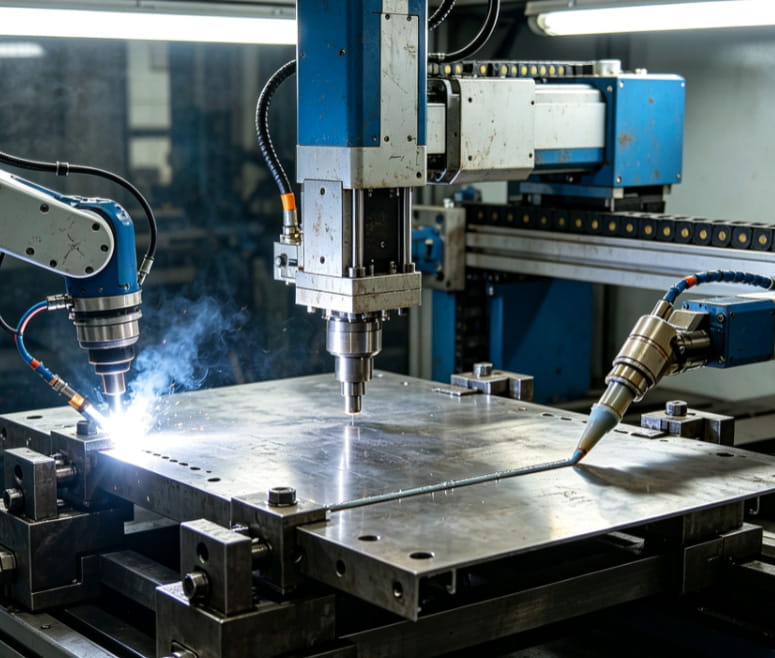
Lightweight NEV bodies widely adopt aluminum alloy sheets, which are prone to welding defects caused by oxide layers when processed via traditional resistance welding. Custom welding equipment supports laser welding and friction stir welding, paired with dedicated aluminum alloy welding tooling treated with heat insulation and anti-oxidation coatings on positioning datums to prevent sheet scratches and oxidation during clamping. The visual positioning system is optimized with imaging algorithms to counteract light reflection on aluminum parts, accurately capturing weld seam contours of pale aluminum alloy and dynamically adjusting laser power to minimize common aluminum welding flaws such as blowholes and cold solder joints. Servo stamping parameters are optimized for the punching process of body structural parts to suit thin aluminum sheets; stamping force is precisely controlled to avoid sheet tearing and deliver smooth, burr-free punching cross-sections.
Battery pack housings demand stringent sealing performance, requiring full peripheral sealing gluing after welding. Custom two-component gluing machines are equipped with constant-temperature glue supply systems developed exclusively for battery sealants, delivering precise control over adhesive mixing ratios and dispensing volume to form uniform, uninterrupted glue beads that block moisture ingress into battery packs. The equipment features explosion-proof protective structures compliant with safety standards for lithium battery workshops, and static-eliminating glue pipelines to mitigate electrostatic hazards posed by adhesives. Integrated battery pack workstations consolidate punching, welding and gluing processes to complete all machining steps in a single workpiece clamping operation, eliminating housing deformation caused by collisions during repeated transfer.
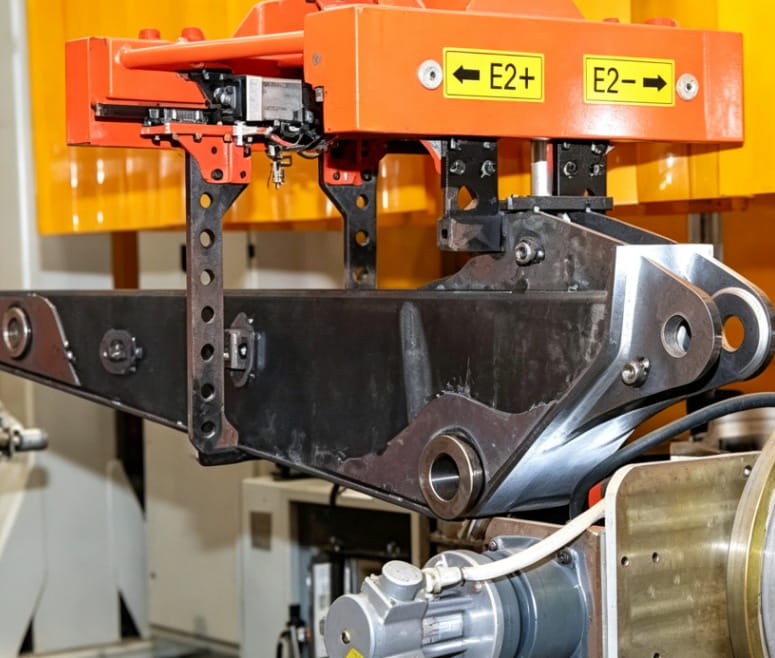
Electric drive housings and motor end covers are mostly special-shaped die-cast aluminum alloy workpieces. Custom tooling adopts multi-directionally adjustable support structures to fit complex curved contours for precise positioning, while soft protective coatings on tool surfaces preserve the surface finish of die-cast parts. The gluing path covers the full-circle sealing groove of housings, and 5-axis linkage dispensing guns adapt to stepped, concave and convex sealing surfaces at multiple angles for zero blind-spot full gluing, ensuring dustproof and waterproof performance inside motors.
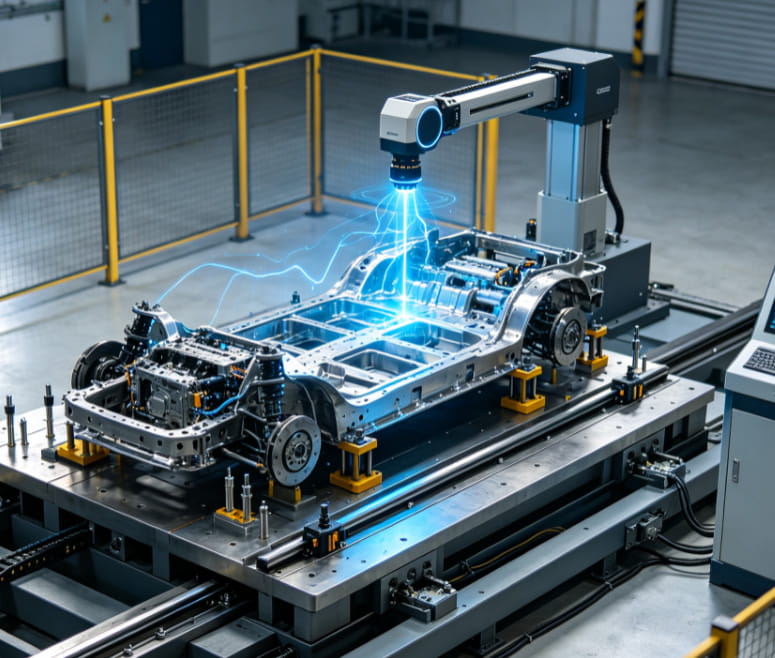
NEV components are subject to far stricter dimensional tolerance standards. All machines come standard with inline visual inspection units that scan weld bead formation post-welding, verify glue path integrity after gluing, and calibrate hole coordinates after punching. Autonomous simultaneous quality inspection is realized across the three processes, with defective workpieces automatically diverted to prevent them from entering subsequent assembly stages. The equipment control system can interface with the MES digital management system of NEV factories to upload real-time machining data of battery packs and lightweight parts, enabling full-process traceability of individual products to meet traceability management requirements of NEV OEMs.
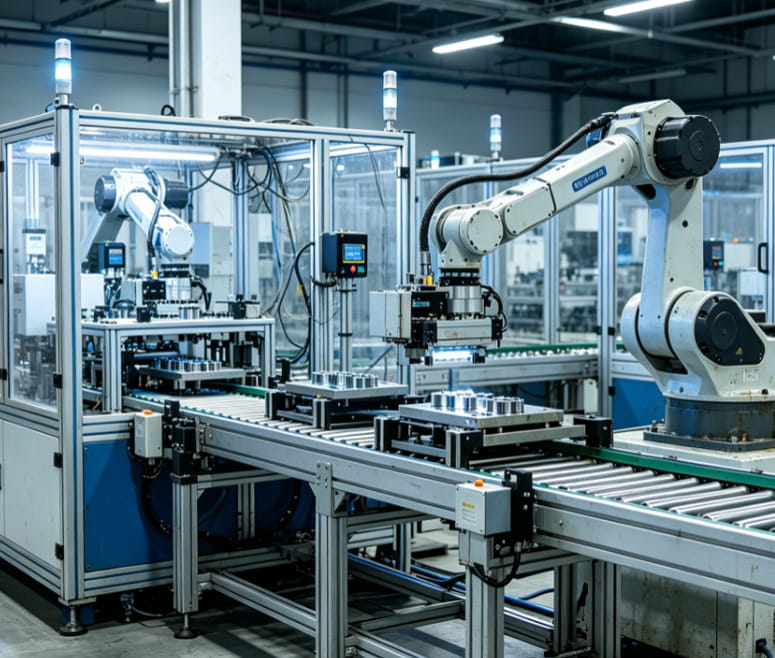
Furthermore, most NEV production lines adopt a multi-model, small-batch mixed production model. All custom equipment adopts modular flexible design matched with quick-change tooling, enabling rapid commissioning when switching between battery packs and body components of different specifications. A single machine supports machining of multiple NEV parts, cutting capital expenditure on multiple independent production lines. Equipment safety standards are also upgraded with multi-layer protection including explosion-proof dust removal, waste gas collection and pressure overload protection to comply with special safety specifications for NEV workshops.
Machining processes for NEV components evolve at a rapid pace, and custom integrated welding, punching and gluing equipment allows functional modules to be adjusted synchronously alongside product process upgrades, extending equipment service life. As market demand surges for lightweight, high-sealing NEV components, custom automated equipment compatible with new materials and special processes will continue to underpin intelligent transformation within the NEV supply manufacturing sector, fulfilling the industry’s development demands for high precision, superior safety and flexible mixed production.