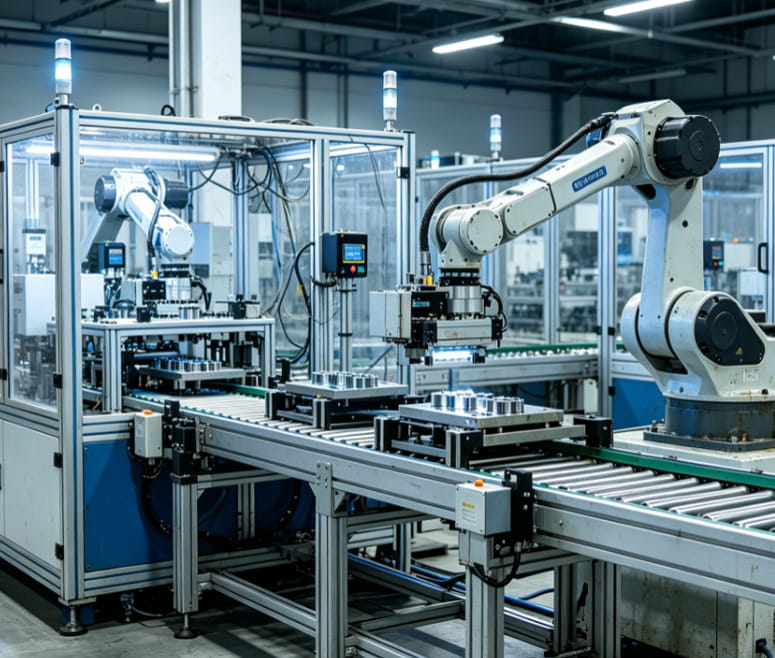
Welding, punching and gluing are core processes widely adopted in the machining of metal parts and automotive supporting components. Under traditional production modes, the three processes are deployed on separate stations. Workpieces require repeated manual handling, clamping and positioning, which not only extends overall production tact time, but also causes positioning deviations from repeated disassembly and assembly, impairing punching accuracy, welding forming and gluing uniformity. Custom non-standard integrated equipment for welding, punching and gluing, paired with exclusive tailor-made tooling, consolidates multiple processes into a single workstation to finish all machining steps in one clamping, effectively resolving all pain points of split production lines.
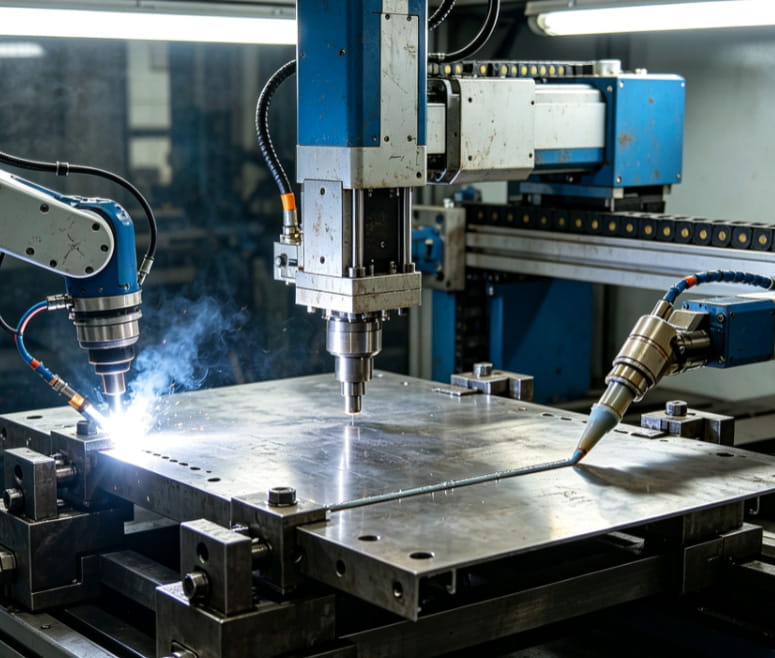
Designed with a centralized layout, the integrated equipment incorporates three core functional modules: welding unit, servo punching module and precision gluing system. All processes are coordinated and linked by the control system with no manual intervention required during process switching.The welding unit is compatible with common processing materials including aluminum alloy, carbon steel and galvanized sheet, and supports mainstream welding technologies such as MIG/MAG welding and laser welding. Equipped with a visual positioning module, it automatically captures weld seam trajectories of workpieces and dynamically adjusts welding travel speed and power to deliver smooth weld beads and evenly distributed welding spots. It reduces common machining defects including cold solder joints, missing welds and weld burn-through, and improves the structural strength of welded assemblies.
The punching process relies on high-precision servo drives and guiding structures. Punching point coordinates are pre-imported into the system, ensuring consistent stamping force and penetration depth for every stroke. Hole diameter, hole spacing and hole flatness are stably controlled to meet dimensional tolerance requirements for subsequent component assembly.The gluing module is fitted with quantitative glue feeding and closed-loop feedback assemblies, compatible with adhesives of varying viscosities such as epoxy glue, sealant and structural adhesive. It precisely regulates glue output per unit length with full control over gluing path and glue layer thickness, eliminating glue overflow, glue breakage and partial missing coating at the source to guarantee reliable bonding and sealing performance of finished workpieces.
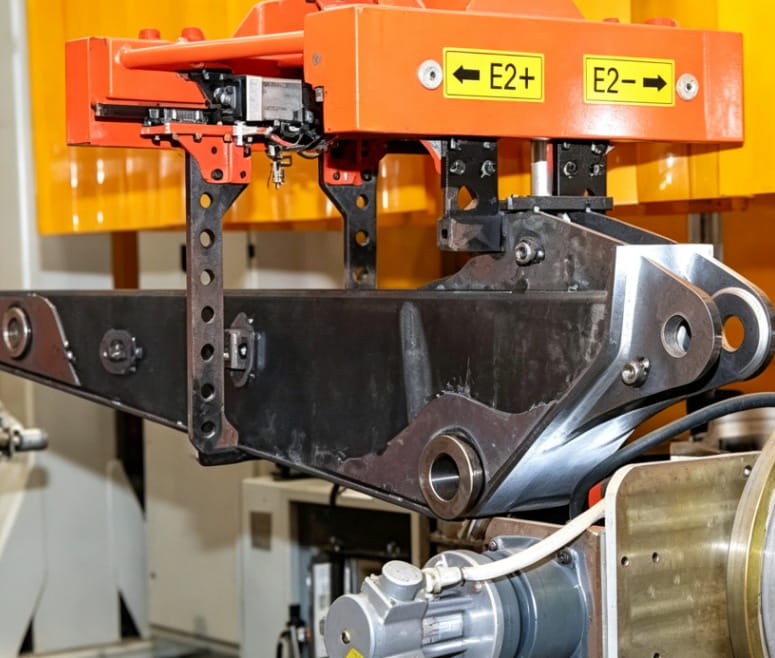
The consistent precision performance of the complete equipment is fundamentally supported by customized matching fixtures. Conventional simple fixtures feature simplistic structures that cannot securely fix special-shaped curved and irregular workpieces. Custom tooling is developed one-to-one according to the 3D contour of each workpiece, manufactured from high-strength wear-resistant materials. Locating pins, support blocks and clamping mechanisms fit the workpiece profile precisely to restrict displacement and vibration throughout the machining cycle.With a split modular design, the workstation can be equipped with multiple sets of interchangeable tooling. Quick disassembly and replacement are available when switching between different workpiece models, drastically shortening changeover commissioning time and boosting overall equipment efficiency (OEE).
Tooling design prioritizes easy operation. Pneumatic or electric driving structures can be configured for clamping and releasing workpieces to cut time spent on manual tightening and reduce operator fatigue. Meanwhile, precise positioning datums are reserved on the tooling to maintain consistent reference coordinates for every clamping operation. This eliminates dimensional errors caused by repeated workpiece handling, unifies the machining datums of welding, punching and gluing processes, and greatly improves dimensional consistency of finished products.
The integrated workstation drastically cuts floor space occupation. It occupies a much smaller footprint compared with three standalone machines, making it ideal for small and medium-sized factories with limited workshop space. The full set of equipment is embedded with self-diagnosis programs that send real-time early warnings for abnormalities such as abnormal welding current, insufficient punching pressure and glue supply interruption, enabling technicians to rapidly troubleshoot and perform maintenance.
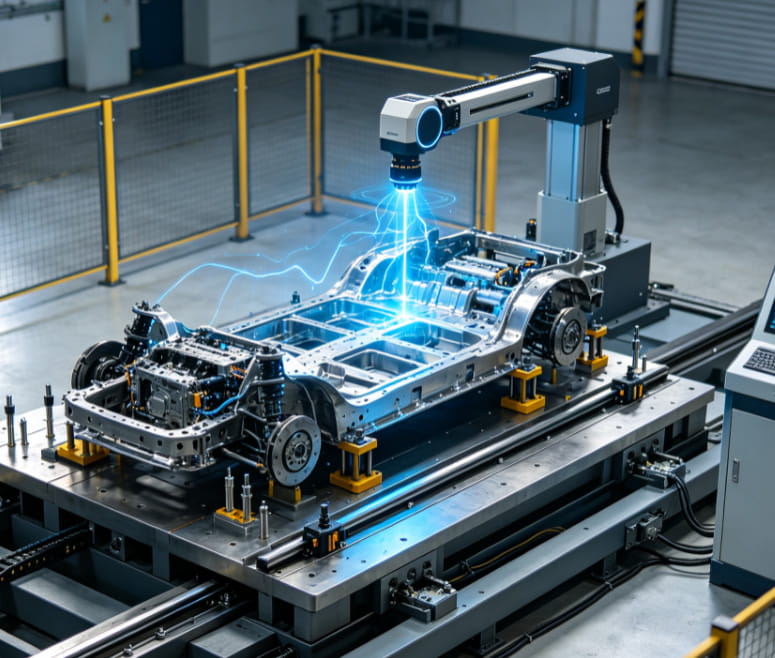
At present, integrated equipment matched with custom tooling is widely deployed for machining automotive chassis components, stamped small auto body parts and hardware sealing fittings. The production model combining integrated processes and precise tool positioning raises hourly output while stabilizing machining quality. It serves as a mature solution for mass production of precision components and aligns with the manufacturing industry’s development trend of process integration and streamlined production lines.