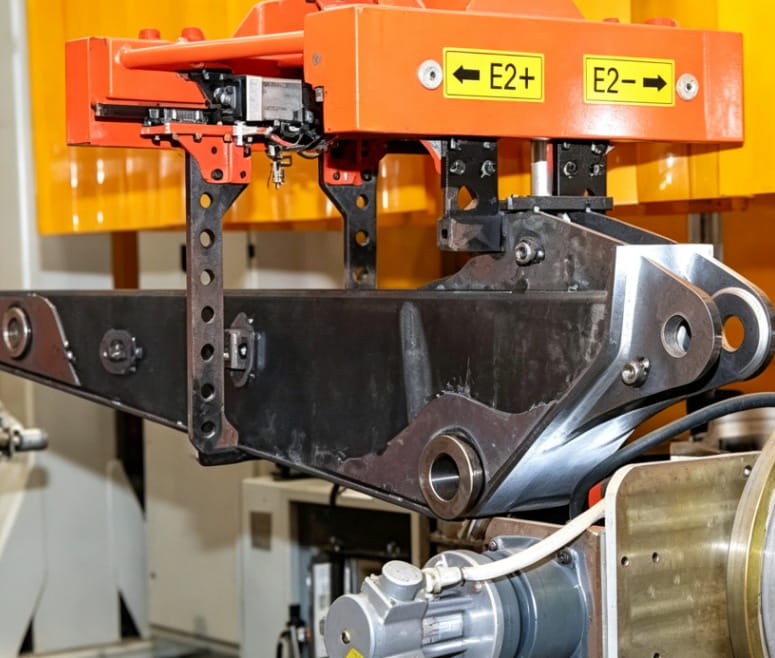
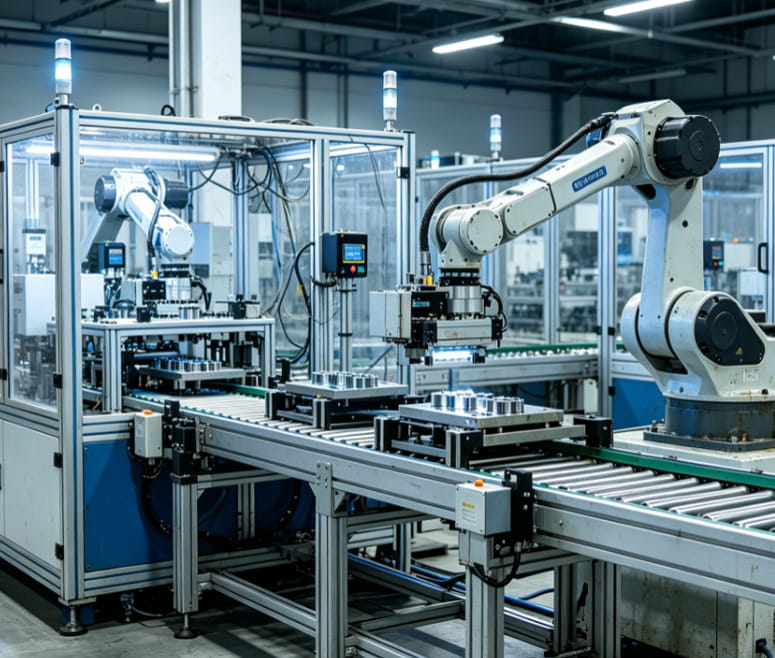
Welding and punching are machining processes that demand rigorous control over displacement, pressure and stroke. Conventional cylinder and hydraulic-driven equipment suffer limited stroke control accuracy, frequently triggering defects such as inconsistent punching depth, torch positioning offset and unstable stamping force. Equipped with high-precision closed-loop displacement control, servo drive systems have become the standard power unit for mid-to-high-end integrated custom welding and punching machines. They deliver consistent machining dimensions at the fundamental power level, catering to mass production of precision components.
A servo system consists of three core components: servo motor, drive controller and high-precision grating encoder, achieving micron-level displacement control. Travel stroke, stop position, movement speed and stamping force are all digitally programmable and adjustable, with real-time value feedback to the control system for closed-loop correction.For punching processes, the servo precisely regulates stamping descent depth and pressure holding duration, and adjusts stamping force according to sheet thickness. It prevents edge cracking on thin sheets and delivers smooth burr-free punching cross-sections for thick plates. Hole diameter and hole spacing remain drift-free during long-term operation, eliminating frequent manual home position calibration.
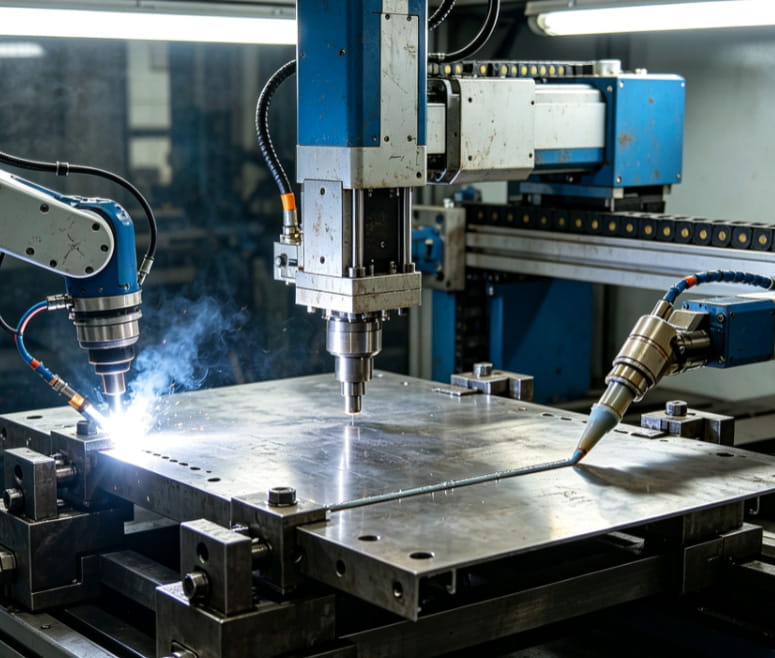
Multi-axis servo linkage modules at welding stations accurately control welding torch travel speed and corner dwell time. Uniform linear travel ensures consistent weld bead width, while automatic deceleration and supplementary welding at corners avoid cold solder joints and weld bead buildup. When paired with arc tracking sensors, the servo enables minor adaptive offset compensation based on weld seam height variation, supporting welding of workpieces with slight sheet deformation. Hundreds of sets of machining parameters for different workpieces can be stored in the motion program, recalled with one click during model changeover to drastically cut commissioning time.
Compared with hydraulic and pneumatic drives, servo systems operate with lower noise and energy consumption. The motor runs at low power during standby, cutting energy costs for long-term mass production. There is no risk of hydraulic oil leakage to maintain a clean workshop environment, and regular hydraulic oil replacement is unnecessary to simplify daily equipment maintenance.Servo motors are embedded with independent overload protection programs. If hard foreign objects block punching or the welding path is obstructed, the system automatically halts and triggers an alarm to prevent motor burnout from overload and crushing damage to tooling and workpieces, lowering equipment repair costs.
The equipment control interface intuitively displays real-time servo coordinates, operating speed, load pressure and cumulative runtime. Technicians can identify guide rail wear and abnormal motor loads via operational data to conduct preventive maintenance and avoid unexpected line shutdowns during mass production.Servo modules adopt a standardized modular structure; faulty single axes can be disassembled and replaced separately without full-machine overhaul, minimizing production line downtime.
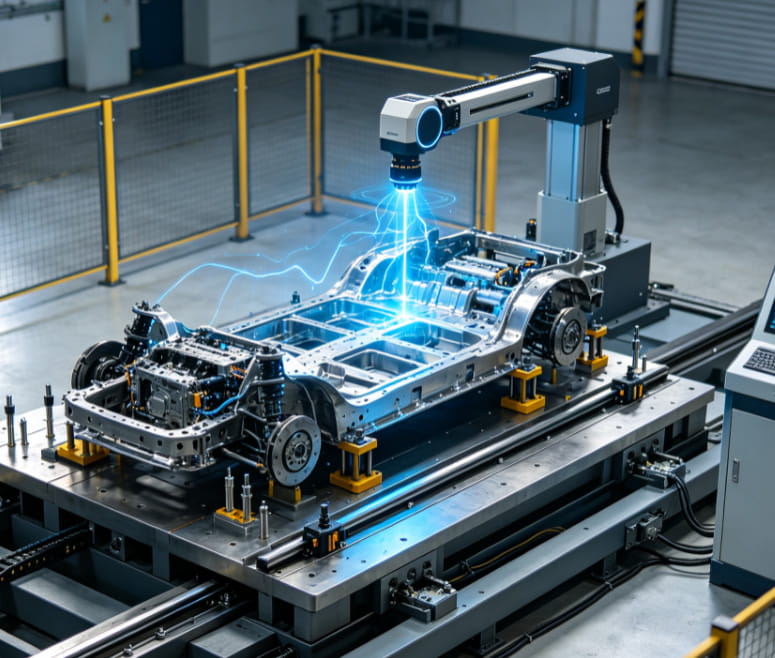
Integrated welding and punching equipment for automotive chassis parts, small body stampings and precision hardware components are commonly equipped with multi-axis servo drive systems, delivering stable machining quality through digital precise power control. As manufacturing industries raise ever higher standards for component machining accuracy and equipment stability, servo drives have become a core configuration for custom precision machining equipment. Integrating multiple strengths including superior machining precision, easy maintenance and energy efficiency, they continuously improve the process stability of component manufacturing.